




Asus ROG Flow X13 GV301RA-LJ011W
Ausstattung / Datenblatt
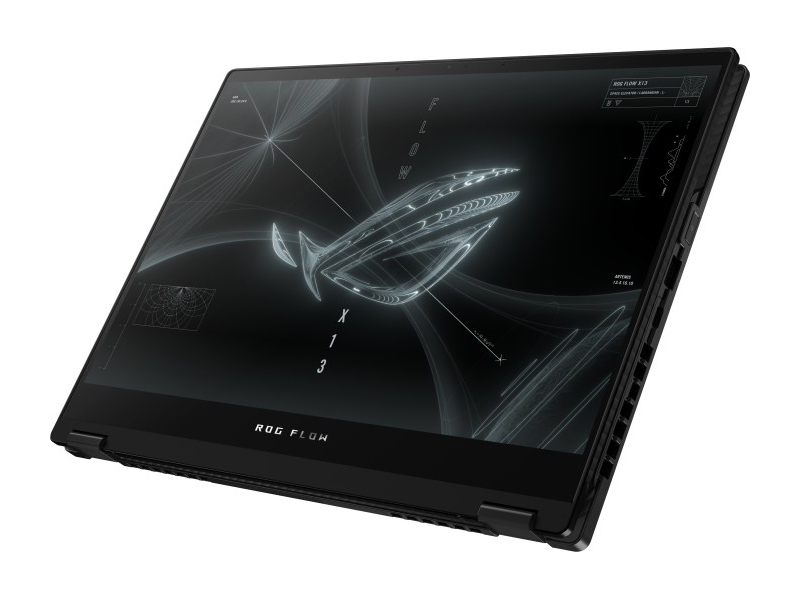
Preisvergleich
Testberichte für das Asus ROG Flow X13 GV301RA-LJ011W
Quelle: Ultrabook Review
 EN→DE
EN→DEBottom point, while we can’t draw proper conclusions on the gaming capabilities of this Flow X13 + XG Mobile combo based on our test unit, I must warn you about the high CPU and GPU temperatures you should expect with these two. With the laptop sitting on the desk, expect 95C on the CPU and 85+C on the GPU with a properly running Turbo mode that allows the GPU to run closer to its designed max power (150W for this 3080 variant, 165W for the 2022 Radeon RX 6850 XT model). Bumping up the laptop in order to improve the airflow into the fans will have a positive impact on the CPU temperatures, but there’s no way to improve the GPU temperatures. I will also add that the ROG Flow X13 is most likely going to get USB4 support in the next couple of months, and that should allow compatibility with other eGPU enclosures beside the XG Mobile, something AMD devices did not offer so far. It’s too early to tell how current Thunderbolt eGPUs are going to work on USB4, but I have some hopes they will do well.
Einzeltest, online verfügbar, Lang, Datum: 07.04.2022
Quelle: Pemmzchannel
 ID→DE
ID→DEPositive: Elegant design; solid workmanship; very long battery life; attractive price.
Einzeltest, online verfügbar, Mittel, Datum: 22.06.2022
Kommentar
Modell:
AMD Radeon 680M: Integrierte Grafikkarte in den Rembrandt Ryzen APUs basierend auf der RDNA2 Architektur mit 12 CUs (= 768 Shader) und einer Taktrate von bis zu 2.400 MHz.
Diese Klasse ist noch durchaus fähig neueste Spiele flüssig darzustellen, nur nicht mehr mit allen Details und in hohen Auflösungen. Besonders anspruchsvolle Spiele laufen nur in minimalen Detailstufen, wodurch die grafische Qualität oft deutlich leidet. Diese Klasse ist nur noch für Gelegenheitsspieler empfehlenswert. Der Stromverbrauch von modernen Grafikkarten in dieser Klasse ist dafür geringer und erlaubt auch bessere Akkulaufzeiten.
» Weitere Informationen gibt es in unserem Notebook-Grafikkartenvergleich und der Benchmarkliste.
R7 6800HS: Mobile APU mit acht Zen 3+ basierten Kernen welche mit 3,2 bis 4,7 GHz takten. Die HS-Variante bietet einen um 10W reduzierten TDP und eignet sich dadurch für dünnere Notebooks. Integriert eine RDNA2 Grafikkarte mit 12 CUs und max 2,2 GHz.» Weitere Infos gibt es in unserem Prozessorvergleich Vergleich mobiler Prozessoren und der Prozessoren Benchmarkliste .


